
Horizontal directional drilling (HDD) is a common way to install or replace gas and oil pipelines in cities without opening a trench. Crews drill a guided, curved bore under roads, railways, or waterways, then pull the pipe through the finished path. This keeps traffic moving, reduces surface disruption, and helps meet environmental and right-of-way limits—especially on road crossings and water crossings.
But trenchless does not mean simple. Urban pipeline HDD is often signal-hostile. Power lines, buried utilities, steel casing, rebar, and dense infrastructure can distort locating signals. Add mixed soils, strict depth tolerances, and inspection requirements, and your locating system becomes a safety and quality tool—not a nice-to-have.
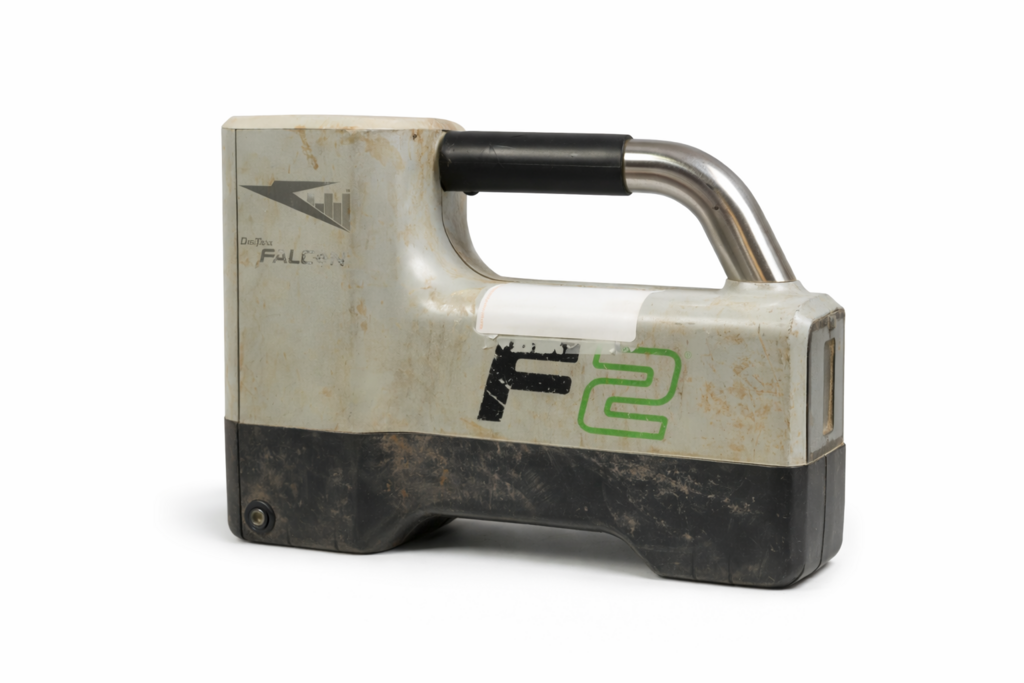
That’s where DigiTrak Falcon F2 fits: pipeline HDD where crews need walkover locating that stays usable in interference-heavy corridors, plus reliable downhole readings that support controlled steering decisions.
What DigiTrak Falcon F2 does on pipeline HDD jobs
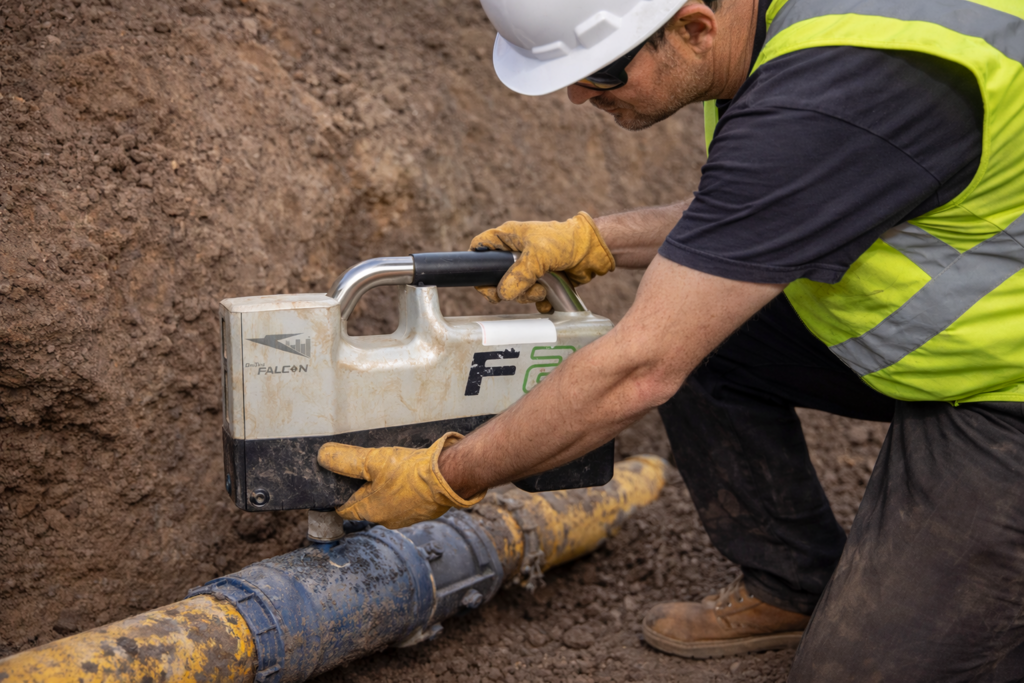
DigiTrak Falcon F2 is a locating system used to track the drill head during HDD. A transmitter (sonde) sits in the drill head and emits a signal. The surface receiver detects that signal and provides the downhole guidance data crews rely on, including:
- Depth
- Pitch
- Roll (clock)
- Signal information needed to establish the locate line and mark the transmitter’s position from the surface
The operator uses these readings to keep the pilot bore on the intended path. On gas and oil projects, “close” is not enough. The bore must stay within design tolerances, maintain separation from existing utilities, and hold up under inspection. In practice, crews document the run rod-by-rod using measured depth and orientation to support QC and acceptance—so the consistency of those readings matters.
Why interference matters in oil & gas pipeline work
Pipeline HDD often runs through places where interference is worst:
- Under highways and major intersections
- Near power distribution corridors and substations
- In industrial zones with dense buried infrastructure
- Around reinforced concrete, rebar, steel casing, and sheet piles
Interference creates two practical problems. First, it can distort the signal and reduce confidence in the locate. Second, it slows the job because crews stop to re-check and troubleshoot. On pipeline work, time lost to uncertainty becomes cost—and it increases risk in the most sensitive zones.
Falcon F2 is used to help keep walkover tracking workable when the site is “loud,” so crews can maintain control instead of switching methods or burning time on repeated verification.
The core advantage: frequency flexibility in interference-heavy corridors
On real pipeline work, the locating challenge is rarely one clean issue. Interference changes along the route. A system is valuable when it gives the operator practical ways to adapt as conditions change.
Falcon F2’s ecosystem is built around broad frequency capability. In simple terms, crews can work through interference by finding a frequency option that performs better in that specific environment, rather than fighting the same noise for hours.
In the field, that typically translates into:
- Fewer stops to chase a usable signal
- Less second-guessing near critical utilities
- More consistent locating behavior as the bore moves through different interference zones
The goal is straightforward: keep the pilot bore moving at a controlled, predictable pace while staying inside the engineered corridor.
Range and depth for typical crossings
Gas and oil crossings range from shallow urban installs to deeper highway or waterway passes. Regardless of depth, crews need the system to stay dependable at the deepest point of the profile—the section where corrections are hardest and risk is highest.
A practical locating setup helps reduce:
- “Signal drop” moments that force slowdowns
- Loss of confidence at the deepest section
- Delays caused by repeated verification passes
More stable tracking across the full depth profile makes the entire project more predictable.
Precision and documentation in pipeline HDD
Pipeline owners care about two outcomes:
- The pipe was installed safely and within tolerance
- The contractor can prove it
Falcon F2 supports this by providing consistent depth and orientation readings that crews use in rod-by-rod control and documentation workflows. Clean records help:
- Confirm the bore stayed on plan
- Support quality control reviews
- Simplify communication with inspectors and project engineers
- Reduce disputes when tolerances are tight
On strict-spec projects, documentation is part of the deliverable. The locating system does not “replace” documentation, but it must provide readings that are stable enough to document with confidence.
Falcon F2 transmitter choices for pipeline HDD
Pipeline HDD is not “one sonde fits all.” Crews select transmitters based on bore length, depth, interference risk, and how sensitive the corridor is. Common selection factors include:
- Expected maximum depth and length of the crossing
- Interference density along the alignment
- How critical the corridor is (utilities, waterways, rail, highways)
- The need for stable, repeatable readings at the deepest point of the bore
On higher-risk crossings, transmitter choice is less about what works in ideal conditions and more about what stays controllable when conditions get messy.
To equip a crew with compatible options for these applications, use the anchor once in your text: f2 falcon sonde.
Where DigiTrak Falcon F2 fits in the pipeline HDD workflow
In gas and oil pipeline projects, HDD is judged by control. The bore must follow a defined corridor, stay within tolerance, and pass inspection without open questions. In this workflow, the locating system is not an accessory. It is part of how the job is built.
Planning the alignment and tolerances
Engineers define where the bore can go, how deep it must stay, and how close it is allowed to pass existing utilities or pipelines. Bend radius is set so the pipe can be pulled without overstress. Critical zones are identified early: road crossings, rail lines, bridge approaches, and areas near live gas mains.
At this stage, requirements are set. If tolerances are tight, the locating approach must produce stable readings and a workflow that supports clean QC records.
Pre-checking interference along the route
Urban and industrial corridors are rarely clean environments. Power, traffic systems, steel, reinforced concrete, and buried infrastructure all affect signal behavior. Interference is not evenly distributed. It changes as the bore advances.
Crews pre-check the route to identify where signal distortion is likely and plan how they will manage it. The goal is not to eliminate interference. That is impossible. The goal is to reduce surprises in the most sensitive zones.
Selecting the transmitter for the job
Transmitter choice directly affects whether the pilot bore stays controllable. On pipeline HDD, crews select sondes based on working conditions, not just catalog ratings. They consider:
- The deepest section of the profile (and a safety margin)
- Interference density in critical zones
- Soil conditions that may affect signal behavior
- The need for consistent, repeatable readings—not occasional “good hits”
On strict projects, choosing correctly upfront prevents slowdowns later.
Drilling the pilot bore with continuous control
The pilot bore defines the entire project. Errors here are amplified during reaming and pullback. Locating must be continuous, and corrections must happen early—before deviations grow.
The real cost of interference is hesitation. When crews do not trust the locate, drilling slows down. They stop, re-check, and second-guess. Falcon F2 is used to help maintain confidence in the locate so the pilot can move forward under control instead of starting and stopping.
Recording the bore profile for QC and inspection
Pipeline HDD does not end when the pilot reaches the exit point. The result must be documented. Bore records show what happened underground, rod by rod. These records support quality control, inspection, and final acceptance.
Clear documentation reduces friction with owners and inspectors. It also protects the contractor. If questions arise later, the records are already there.
Reaming and pulling back with confidence
When the pilot bore is clean and verified, the remaining steps become more predictable. Reaming follows a known path. Pullback forces are easier to manage. The pipe experiences less stress.
Many pullback issues trace back to pilot errors. That is why stable locating and disciplined documentation in the early stages reduce risk at the most expensive phase of the project.
Bottom line
DigiTrak Falcon F2 is used in gas and oil pipeline HDD projects because it helps crews keep walkover locating workable in interference-heavy corridors and provides dependable downhole readings for controlled pilot drilling. On projects with tig